

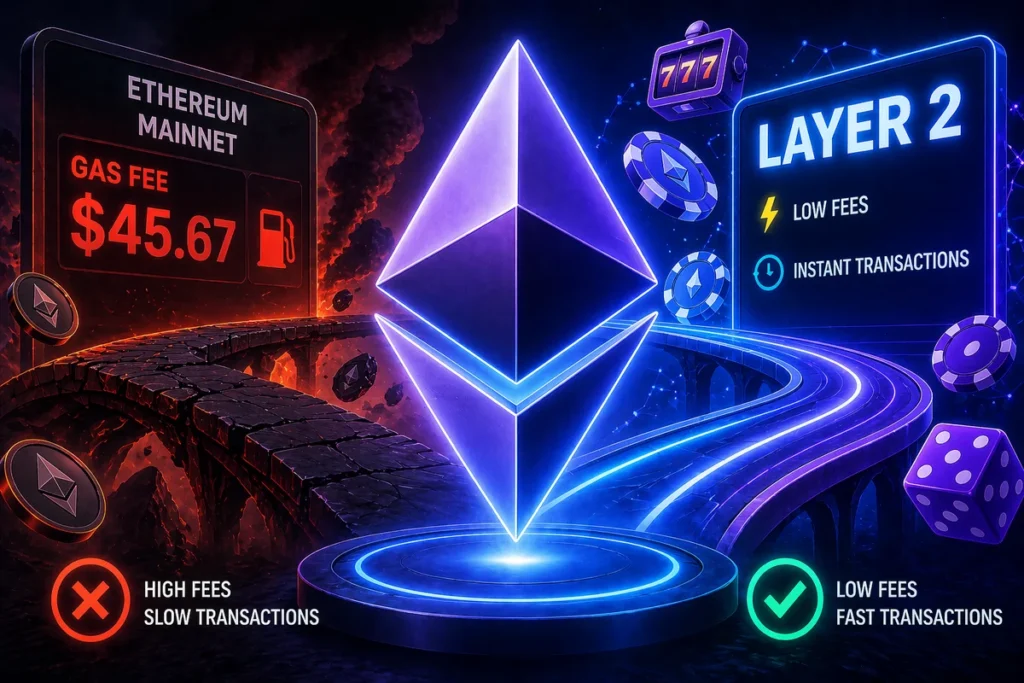
I used to burn way too much Ethereum (ETH) just moving funds in and out of gambling sites, costing me a hefty chunk of my winnings. Thankfully, Layer 2s have completely solved these issues. These networks, which are built on the Ethereum mainnet, offer 90% lower fees and instant transactions. A mainnet is just an independent blockchain where transactions are recorded and verified, whereas Layer 2s are solutions built on top of the mainnet.
In this guide, I’ll walk you through how to use Ethereum Layer 2s for online gambling, including how they work and how to bridge funds, deposit, and withdraw. Are you ready to learn about the best networks? Let’s slash gas fees together!
What Are Ethereum Gas Fees?
Gas fees are transaction costs required to use the Ethereum blockchain. Every time you send ETH, it utilizes computational effort. To compensate for this effort, you pay gas fees, which are tips to validators in Ethereum’s proof-of-stake system for processing the transaction.
Gas is a unit of measurement that measures the amount of computation effort required to process a transaction. Fees are priced in Gwei, which is a fraction of ETH, and 1 billion Gwei equals 1 ETH.
Your fee is calculated by multiplying the current gas price by the required gas for the transaction to be completed. Gas price varies based on network congestion, and the amount of gas required also shifts depending on the type of transactions you’re performing.
Due to the amount of activity on the Ethereum blockchain, performing simple transactions can become prohibitively expensive. I remember once when I was trying to bridge $20, the gas fee was $30, making the transaction a waste of time. Fortunately, Layer 2s are an easy solution that can slash fees by over 90%!
What Are Layer 2s?
Layer 2s (L2s) are blockchain networks built on top of Ethereum that process transactions off-chain, then settle them on Ethereum in bulk. They are designed to solve Ethereum’s biggest problems: slow transaction speeds and high gas fees. L2s like Optimism, Base, Arbitrum, and zkSync all make Ethereum faster and cheaper and improve scalability.
Unlike Ethereum mainnet (Layer 1), which handles every transaction individually, L2s bundle thousands of transactions together and post a compressed proof to the mainnet. This allows transactions to be processed within seconds, and fees are often under $0.10. This makes Layer 2s ideal for online gambling.
There are two main types of Layer 2s: Optimistic Rollups and ZK Rollups. An Optimistic Rollup works by having users deposit funds into a smart contract that connects Ethereum with the Layer 2 network. A special node called a “sequencer” handles transactions off-chain, bundling them together and posting them to Ethereum in a single, compressed batch, which dramatically reduces costs and congestion.
Optimistic Rollups assume all transactions are valid and only run fraud checks if someone disputes a transaction. To allow time for challenges, withdrawals can take up to 7 days.
ZK Rollups generate cryptographic proofs that transactions are valid and submit them to Ethereum. This makes them extremely secure and allows for instant or ultra-quick settlement.
Layer 2s don’t compete with Ethereum. Instead, they improve the network and generate gas fees for validators. Layer 2s still rely on Ethereum to run and for security. As more users and dApps are migrating to L2s, crypto is becoming more accessible, and we’re seeing impressive developments in everything from DeFi to smart contracts to decentralized gambling.
Pros:
- Significantly cheaper gas fees
- Instant transactions
- Improves scalability of Ethereum
- Lower energy usage
Cons:
- More complex to use than Ethereum mainnet
- Not every wallet and casino supports L2s
- 3rd party bridges and oracles are potential attack vectors
Best Layer 2 Networks for Gambling
If you’re looking for Layer 2s that offer the perfect combination of speed and security with rock-bottom gas fees, you can’t go wrong with any of these networks:
Arbitrum
Arbitrum is one of the most widely adopted Layer 2 rollups, developed by Offchain Labs. It uses Optimistic Rollup technology, which means transactions are assumed valid unless challenged. This design allows Arbitrum to process thousands of transactions per second at a fraction of Ethereum’s gas cost.
What sets Arbitrum apart is its custom-built virtual machine, the Arbitrum Nitro stack, which compresses calldata more efficiently than its competitors. Arbitrum also boasts massive adoption across dApps, including DeFi heavyweights like GMX and Uniswap, and decentralized betting platforms.
As Arbitrum uses fraud proofs with a seven-day challenge window, withdrawals to the Ethereum mainnet can be painfully slow if you go through the standard route. Fortunately, many platforms now integrate liquidity exit bridges, such as Hop or Across, which allow you to withdraw in seconds for a small fee.
Optimism
Optimism is another Optimistic Rollup network and one of Arbitrum’s main rivals. It works in a similar way by bundling transactions and posting them to Ethereum. Optimism has its governance token, OP, and hopes to inflate the token 2% every year. You can also use the token to earn additional rewards by playing games, trading on decentralized exchanges, and acquiring NFTs.
Polygon
Polygon is a multi-chain platform that enhances Ethereum’s scalability using Layer 2 solutions, like Plasma, zk-Rollups, and Optimistic Rollups. It supports high throughput up to 65,000 transactions per second, making it ideal for high-demand applications.
From what I’ve seen, Polygon also offers significantly lower transaction fees than Ethereum’s mainnet. With a strong focus on interoperability, it connects various blockchains to enable seamless interaction. Polymarket, a popular decentralized prediction market platform, uses Polygon as its only Layer 2.
Base
Base is built by Coinbase on top of the Optimism stack. With this network, you get the low gas fees of Optimistic Rollups combined with Coinbase’s user-friendliness and trustworthy brand. It’s fully EVM-compatible, meaning any Ethereum dApp can easily port to Base.
I’m a big fan of Base because it’s seamlessly integrated with Coinbase’s wallet and exchange, making it easy to send/receive, swap, stake, and exchange tokens. Also, moving between crypto and fiat is super smooth.
zkSync
zkSync is the leading ZK-Rollup Layer 2 built by Matter Labs. It uses zero-knowledge proofs to instantly verify thousands of transactions and settle them on the Ethereum mainnet. This network offers faster finality, instant withdrawals, and stronger cryptographic security compared to other Layer 2s. ZkSync isn’t as widely accepted as Arbitrum, but it’s quickly expanding, I expect to hear a lot more about this L2 in the future.
How to Use Layer 2s to Gamble
Using Ethereum Layer 2s at top crypto casinos is a smart way to save on gas fees and speed up your bets. It gives you the power to reload your account within seconds, which is perfect if you’re live betting on hockey or want to hop into the next round of Plinko. Layer 2s also slash withdrawal times. On average, cashouts take 30 seconds to hit my wallet.
To use a Layer 2 to gamble, you’ll first need a crypto wallet like MetaMask with some ETH on the Ethereum mainnet. From there, use a trusted bridge, such as bridge.arbitrum.io, to move your ETH from Layer 1 to Layer 2.
After you’ve bridged your ETH, you just switch your wallet to the new L2 network and transfer your tokens to your online casino or sportsbook of choice. Alternatively, you could gamble at a decentralized betting platform and gamble directly from your wallet, thanks to the power of smart contracts!
How to Bridge ETH
Bridging Ethereum means transferring ETH from the Ethereum mainnet to a Layer 2 network so you can take advantage of lower fees and faster transactions. Here’s how to bridge ETH using Arbitrum:
- Go to https://bridge.arbitrum.io/.
- Select the network you want to bridge and the receiving network.
- Enter the amount of ETH you wish to bridge.
- Click Connect Wallet (OKX, Coinbase, and MetaMask are all available).
- Scan the QR code.
- Press Move Funds.
After you’ve completed the transaction, your Ethereum will be on your Layer 2 of choice and ready to be used!
How to Deposit Using a Layer 2 Network
To add funds to your crypto casino account via a Layer 2, follow these steps. Trust me, it’s easier than you think!
- Open your wallet and switch to the Layer 2 network.
- Go to a crypto casino that supports your chosen L2 network and connect your wallet.
- Hit the Deposit button, select Ethereum, and enter the amount you wish to deposit.
- Copy the address displayed.
- Open your wallet, paste the address, and complete the transaction.
Thanks to the power of Layer 2s, your Ethereum will arrive in your casino account within seconds. Then you can put your ETH to good use as you play progressive jackpot slots, crash games, live blackjack, and more!
How to Withdraw from Layer 2
Forget about paying $5+ for transactions and waiting hours for your winnings to arrive. Instead, withdraw via a Layer 2 and pay less than $0.10 and receive your payout in under 30 seconds. To cash out, follow these steps:
- Log in to your casino account and head to the withdrawal page.
- Select Ethereum and your L2 network of choice.
- Enter your wallet address and the amount of ETH you wish to withdraw.
- Double-check the address and confirm the transaction.
From your wallet, you can bridge your Ethereum back to the mainnet, swap it for another token, or even exchange it for fiat!
Things to Consider Before Using Layer 2s
I’m a big fan of using Layer 2s for online gambling. I’ve saved thousands of dollars by transacting via Optimism, Arbitrum, and other blockchain-based operating systems. However, there are some trade-offs you need to be aware of.
- Security and withdrawal delays – Security on Ethereum Layer 2s depends on the underlying protocol; most are safe but introduce new risks. Withdrawal delays, especially on Optimistic Rollups, can take up to 7 days due to fraud-proof windows. Some platforms offer faster withdrawals via liquidity providers, but these may come with added fees or trust trade-offs.
- Casino support and wallet compatibility – Not every crypto gambling site supports every L2, and not every wallet auto-detects L2 networks without manual setup. Always verify that your chosen online casino or sportsbook is compatible with the L2 network you’re using and that deposits and withdrawals are seamless. Otherwise, you might get surprise fees when bridging between Layer 2s.
- Decentralization and KYC – Some L2 casinos operate on fully anonymous protocols, while others run centralized platforms and use L2s for speed. If anonymity, censorship resistance, or Provably Fair gaming is important to you, pay attention to how the casino is structured and how Layer 2s are integrated.
- On-ramp availability – Not all fiat-to-crypto ramps support L2s directly. After you’ve purchased ETH using your fiat currency of choice, you may need to manually bridge from the Ethereum mainnet to an L2, which can be time-consuming and costly.
Layer 2s: Your Shortcut to Cheap & Fast Ethereum Transactions
Since switching to Layer 2s, I’ve saved a fortune on gas and now never have to anxiously check the blockchain to see where my withdrawal is. Also, thanks to widespread wallet and casino support, ditching the Ethereum mainnet is super easy.
If you haven’t made the leap yet, now’s the time. Bridge your ETH, find a casino that supports L2, and take advantage of instant transactions that cost under $0.10!