

Crypto bros definitely speak their own language, a mix of slang, acronyms, and inside jokes that can leave you scratching your head. From “HODL” to “Wen Lambo,” it’s like learning a secret code.
Don’t worry, I’ve got you covered! I’ll break down all the common phrases and some of the more esoteric ones that even Vitalik Buterin might raise an eyebrow at. Welcome to Crypto Gambling Slang 101. Class is now officially in session!
Provably Fair
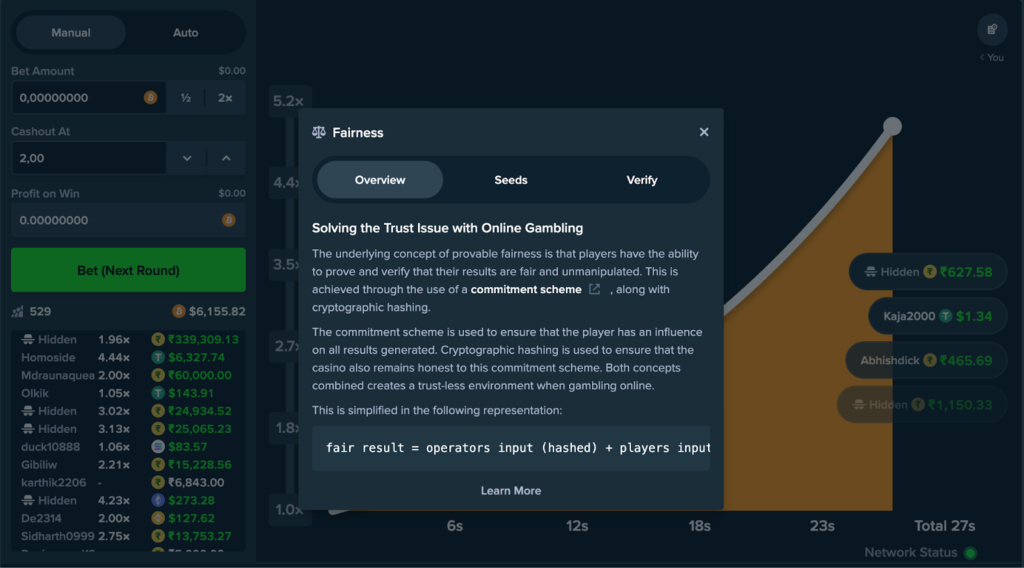
Provably fair is a blockchain-backed technology that lets you verify that a game’s outcome wasn’t tampered with. It works by using a combination of a server seed (from the casino) and a client seed (from the player), along with a cryptographic hash, to generate random results. After the bet, you can check the hash and seeds to confirm the result was fair.
At LuckyHat, we feature a page dedicated entirely to crypto casinos with provably fair games. BC.Game and Winz.io are my personal favourites, offering classics like Crash, Dice, and Mines. They even include simple step-by-step guides so you can verify the fairness yourself in seconds.
Hash
A hash is a cryptographic fingerprint of data. In provably fair gambling, hashes are used to verify that the server seed hasn’t been changed after you placed a bet. For example, before a dice roll, the casino shows you the hash of the server seed. After the game, you can compare the revealed seed to the hash to ensure fairness.
Seed
In provably fair games, a seed is the random value used to generate results. There’s a server seed (from the casino) and a client seed (from you). You can change your client seed to get a different sequence of results.
RTP
RTP (Return to Player) is the percentage of your wagers that a game is expected to pay back. For example, a slot with 96% RTP will theoretically return $96 for every $100 wagered, though short-term results can vary wildly as the pay out rate is calculated over millions of spins. You can find a game’s RTP by opening the pay table or by going to the software provider’s official website.
At crypto casinos, slot RTPs are typically around 95% to 96%. If you’re looking for high payout games, Blackjack, Baccarat, Video Poker, Crash, and Mines all have 98%+ RTPs.
RNG
RNG (Random Number Generator) is the tech brain behind casino games, ensuring the results are truly unpredictable. In traditional online casinos, RNGs run on certified software, while blockchain casinos often use provably fair RNGs.
Pragmatic Play slots run on certified RNGs whereas BC.Game’s Crash uses cryptographic seeds and hashes to prove fairness in real time. Not all RNGs are the same, look for ones that have been audited by independent testers like eCOGRA or iTech Labs.
Originals
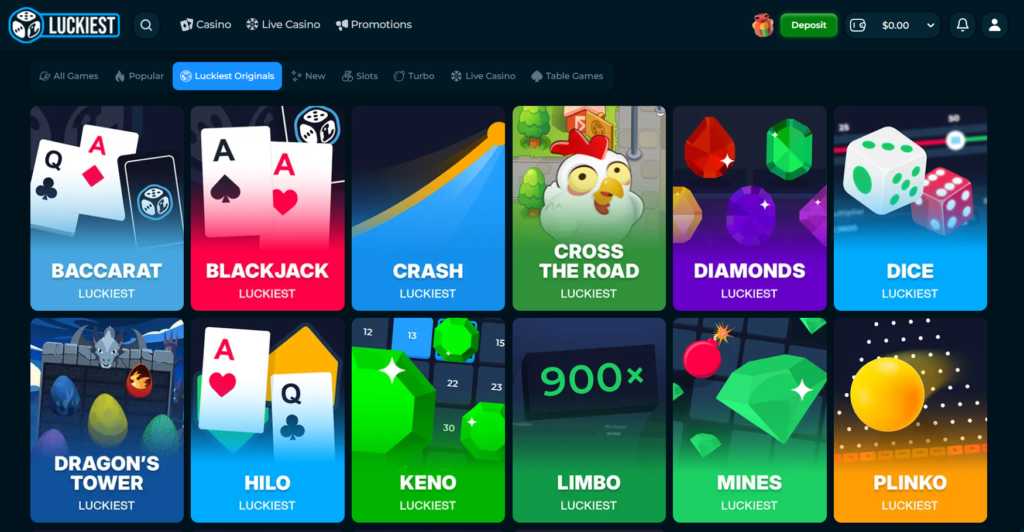
In crypto gambling, Originals refer to in-house games developed by the casino itself rather than third-party providers. These often include instant games like Dice, Mines, Crash, and HiLo and are known for being provably fair and having tiny house edges.
Stake was the first crypto casino to release Originals back in 2017, but now other sites like Luckiest have jumped on the trend. Luckiest offers 16 Originals, including Plinko, Crash, Video Poker, and Roulette! The best part? They’re all Provably Fair.
Crash
Crash is a popular crypto casino game where a multiplier rises from 1x until it “crashes” at a random point. Your goal is to cash out before the crash. For example, betting $100 and cashing out at 10x wins $1,000. In BC.Game’s Crash, the max win is an epic $1 million per round!
Crash emerged in 2014 with Bustabit, the first crash-style game created by the Bitcoin community. It gained popularity on Bitcointalk thanks to its low minimum bets, unlimited multipliers, and 99% RTP. Then when you throw in the game’s provably fair system and in-game chat, it’s easy to see why crash games like Aviator have over 10 million monthly active players!
Mines
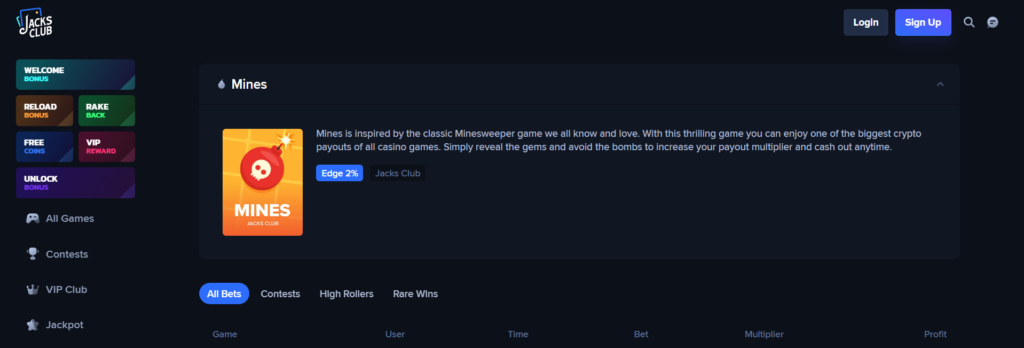
Mines is a crypto casino twist on the classic Minesweeper game. You pick tiles on a grid, trying to avoid hidden mines while revealing multipliers or prizes underneath. The more safe tiles you uncover, the higher your potential win. But one wrong pick and you lose it all.
At any moment, you can choose to collect your winnings or progress towards the next tile and hopefully a bigger payday. Play Mines at Jacks Club!
Plinko
Plinko is a classic crypto game where you drop a ball from the top of a pegged board and watch it bounce into multiplier buckets. Before playing, you choose the number of pegs and your risk level: high (huge top multipliers but also buckets as low as 0.20x), medium, or low (smaller top multipliers but fewer buckets below 1x). The ball’s path is unpredictable, and every bounce adds to the suspense.
Check out our ranking of the best crypto casinos that have Plinko!
Dice
Dice is the OG crypto casino game, simple enough for your grandmother but wild enough to keep degens glued to the screen. You pick a target number and bet if the roll will be above or below it. The lower the chance, the bigger the multiplier. Every roll can end in glory or disaster.
Dice is a hit because you can tailor your risk. Opt to play it safe for steady 1:1 payouts or go all-in chasing insane 1,000x+ multipliers. Dice also offers a 99% RTP, giving you a great shot at emerging a winner. Try it at mBit Casino!
HiLo
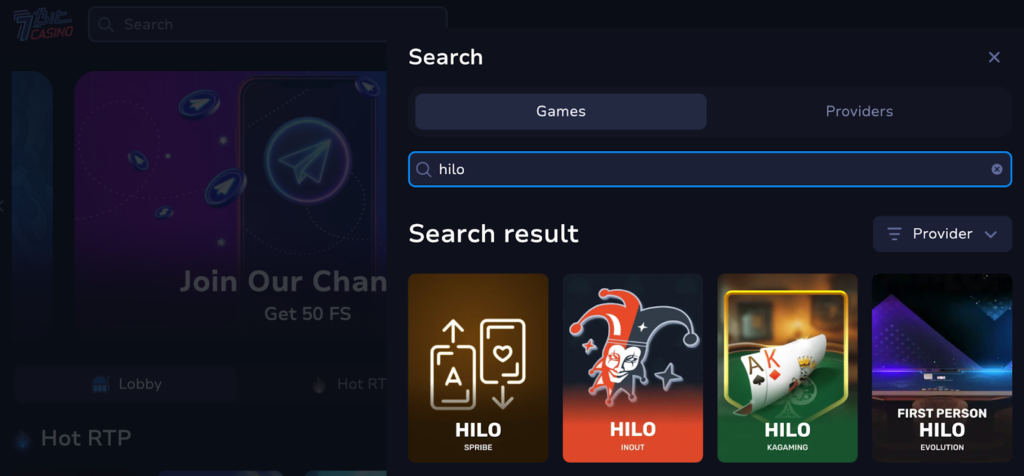
HiLo is a simple crypto game where you predict whether the next card will be higher or lower. Each flip is instant, so the tension builds fast, and one good streak can turn a small bet into a serious win. You choose when to stop and cash out or keep going to scoop up bigger rewards. It’s very similar to Casino War and is available at all top crypto casinos, including BC.Game and 7Bit Casino!
Martingale
The Martingale is a betting strategy where you double your stake after every loss, aiming to recover all previous losses plus a profit equal to your original bet. For example, bet $1, and if you lose, your next bet is $2. Lose again, then bet $4. Win, and you’re up $1 overall.
While it works in theory, it needs a large bankroll and no betting limits. Martingale is best suited to games with close to 50/50 odds per round, like HiLo, Roulette (Red/Black), and Baccarat.
KYC
KYC (Know Your Customer) is the identity verification process casinos and financial platforms use to comply with anti-money laundering laws. It usually involves submitting documents like your passport, driver’s license, and proof of address. While many crypto casinos offer anonymous, no-KYC play for privacy, licensed ones such as Katsubet often require it for large withdrawals or bonus claims.
You’ll encounter KYC when you try to cash out significant winnings or when the casino suspects suspicious activity. For example, if you win 10 ETH and try to withdraw it, the casino may freeze the withdrawal until you pass KYC.
Rakeback
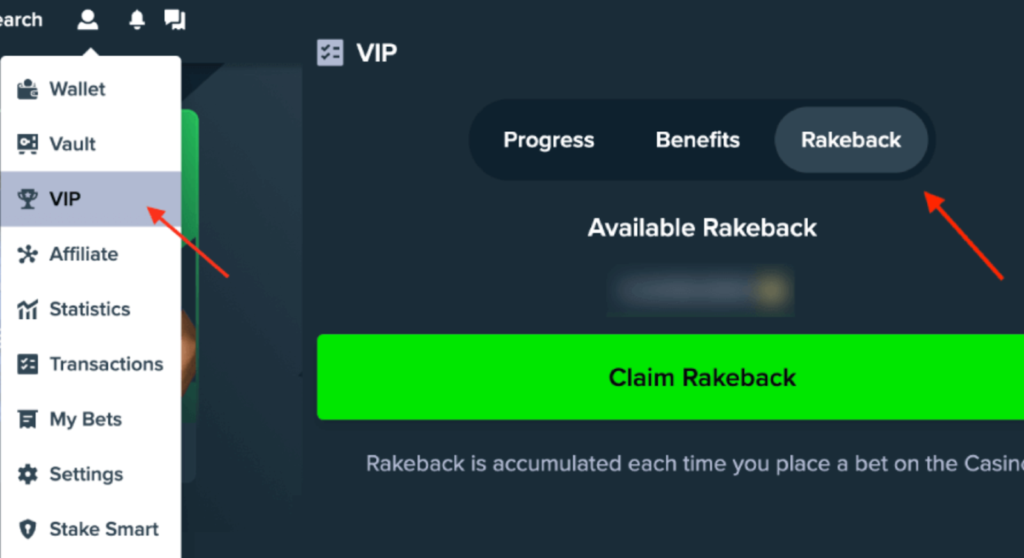
Rakeback is when a crypto casino returns a percentage of the house edge you’ve paid back to you. For example, if you play a slot with a 4% house edge, claim 2% rakeback, and wager $20,000, you’ll get $16 back, irrespective of if you win or lose.
At Stake, every player automatically gets 5% rakeback, meaning you earn back 5% of the casino’s cut on your bets. For top players or VIPs, rakeback can be much higher, sometimes reaching as much as 35%, significantly boosting your long-term value while playing. This ongoing bonus effectively increases the RTP of all games.
Stablecoin
A stablecoin is a cryptocurrency pegged to a fiat currency like the US dollar. Examples include USDT, USDC, and DAI. Many crypto casinos accept stablecoins so players avoid volatility during play. For example, betting in USDT on 7Bit Casino means your winnings won’t change value overnight due to Bitcoin price swings.
Satoshis
Satoshis (or sats) are the smallest unit of Bitcoin. 1 satoshi equals 0.00000001 BTC. Many crypto casinos like BC.Game display BTC bets in sats for precision. For example, betting 1,000 sats is the same as betting 0.00001 BTC.
You’ll run into this term when setting micro-bets, especially in high-speed games like Crash or Dice, where players bet just a few sats per round. Casinos often use sats to appeal to both high rollers and budget players, since Bitcoin’s high price makes betting in whole BTC unrealistic.
Blockchain
The blockchain is a decentralized digital ledger that records transactions transparently. In gambling, it’s used to process crypto payments, power provably fair games, and even run decentralized casinos.
House Edge
The house edge is the built-in advantage the casino has over players, expressed as a percentage. It’s the opposite of the RTP, which is what the player is expected to receive back. If a game has a 1% house edge (99% RTP), it means the casino expects to make 1% profit on all bets over time.
Bag
A bag is your bankroll and represents the amount of a particular coin you’re holding. In Aviator’s player chat, you might brag about the size of your BTC bag. For example, after a big win you might say you’ve “stacked your bag” with another 0.2 BTC. This term is used in both investment and gambling contexts whenever people talk about growing their crypto holdings.
Whale
A whale, also known as a high roller in crypto gambling, is a player or investor with huge amounts of crypto who can influence the market or game lobbies. In casinos, whales are the ones betting 5 BTC per round in live baccarat. At crypto exchanges, whales can pump or dump a coin’s price with a single transaction.
BC.Game has a cool function where you can see other players’ bets. You can follow along as the whales wager your net worth on every hand!
Gas Fees
Gas fees are blockchain transaction costs paid to miners or validators to process your transaction. You’ll need to pay gas fees when depositing and withdrawing from a crypto casino.
The average gas fee is $1.45, but it jumps around due to network congestion. You can slash transaction costs by using Layer 2s, which bundle multiple transactions together and reduce fees to under $0.10.
Dust
Dust refers to tiny crypto amounts left in your account after betting or withdrawing, which are too small to meet minimum withdrawal limits. If you have 0.00000087 BTC left in your casino wallet on Cloudbet, that’s dust.
Some casinos let you convert dust into their house tokens or use it in special micro-bets. In other cases, it just sits there until you top up your balance. You’ll also hear the term in crypto wallets, where dust is the leftover change from a transaction that’s uneconomical to send due to gas fees.
Crypto Exchange
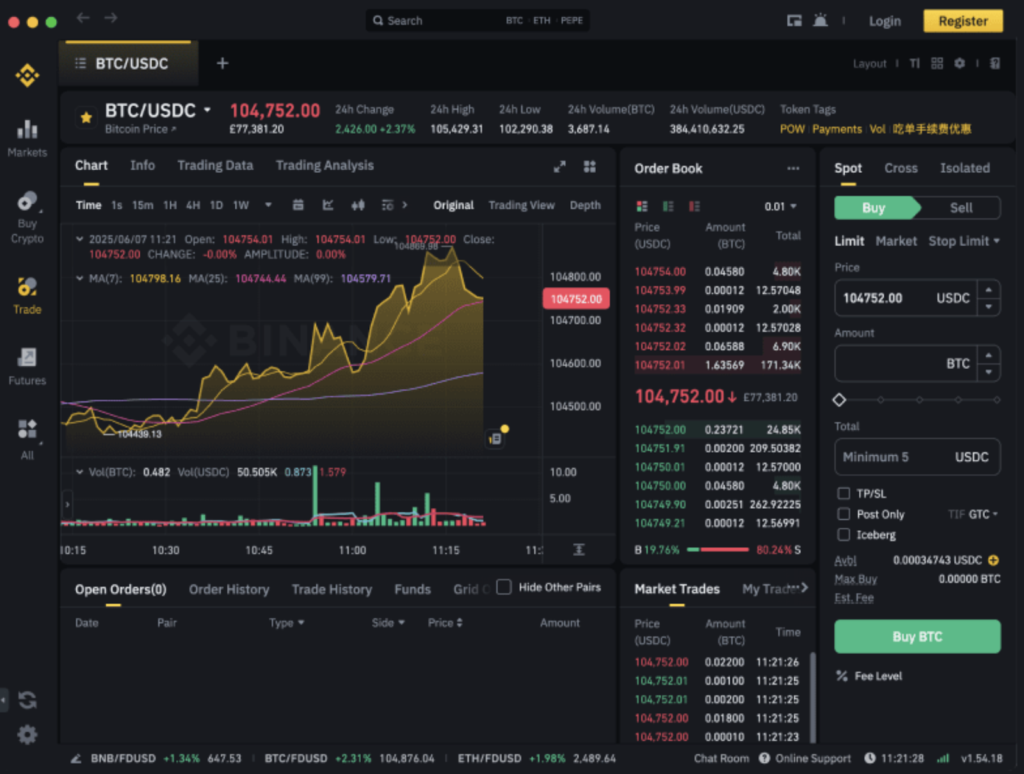
A crypto exchange is where you buy, sell, and swap cryptocurrencies. The top exchanges are Binance, Coinbase, and Kraken, each offering hundreds of coins, competitive fees, and secure trading environments. These platforms let you trade instantly, automate your buys and sells, and many also provide extra features like staking, futures trading, and leverage.
If you don’t already have crypto, start by converting your fiat currency on a trusted crypto exchange by buying your preferred cryptocurrency. Once you have it, transfer the tokens from the exchange to your betting site’s wallet address to make your deposit.
Hot Wallet
A hot wallet is a crypto wallet connected to the internet, which is used for quick deposits and withdrawals. Casinos store player funds in hot wallets for instant payouts. For example, when you withdraw from a crypto casino, the funds often come from a hot wallet. The trade-off is lower security compared to cold wallets. You’ll encounter hot wallets when making instant deposits via QR code or wallet address.
Cold Storage
Cold storage refers to keeping crypto in an offline wallet, making it immune to online hacks. Casinos use cold storage for the majority of their funds to protect against breaches. For example, Cloudbet processes large withdrawals from cold storage after manual review.
We also recommend you store your crypto tokens in a cold wallet like Ledger Nano X. This way, even if a hacker gets access to your device, your crypto assets are still safe!
Airdrop

An airdrop is when free tokens are distributed to wallets, often as a promotion. Casinos may airdrop their native tokens to attract players. For example, BC.Game sometimes airdrops $BC tokens to VIP players’ accounts. You’ll encounter airdrops in casino marketing campaigns, DeFi gambling platforms, and NFT betting projects as a way to incentivize sign-ups or loyalty.
Shilling
Shilling is the act of promoting a token, blockchain project, or crypto casino, often for personal gain. An influencer might hype up a new betting site without disclosing they’re earning commissions from it.
Platforms like X and Telegram are flooded with people shilling everything imaginable, so it’s important to recognize the bias behind these promotions and treat their recommendations with healthy skepticism.
Wagering Requirement
A wagering requirement is the amount you must bet before you can withdraw bonus winnings and can be found in the casino’s T&Cs section. If you get a $100 bonus with a 40x wagering requirement, you must bet $4,000 before cashing out. Ideally, you want the wagering requirement to be as low as possible.
Rug Pull
A rug pull is when a project’s developers abandon it and run off with investor funds. In gambling, this might happen with shady casinos or DeFi betting platforms where the owners drain the liquidity pool. This is why you need to be very wary of unlicensed crypto casinos with bonuses that look too good to be true, especially if they’ve only been around a few months!
HODL
Originally a misspelling of “hold” from a frantic 2013 Bitcoin forum post, HODL became a rallying cry in the crypto world, urging investors to cling to their coins through wild price swings.
In the gambling scene, it’s taken on a cheeky twist. Instead of cashing out after a win, players might HODL their BTC in the hopes the next bull market will turn their score into an even bigger payday.
Say you hit a 0.10 BTC win on Cloudbet, and instead of converting it to fiat, you ride the volatility waves, resisting and watching it double in value. In Aviator chats, you’ll even see people spamming HODL! in all caps as the multiplier soars or muttering it like a prayer to the crypto gods for one more surge.
Tokenomics
Tokenomics refers to the economics behind a cryptocurrency project and focuses on supply (number of tokens), demand (who is willing to buy), utility (how it will be used), and distribution (who will receive it and how). Many crypto casinos launch their own tokens to fund their betting sites. Holders of tokens often get special bonuses and other perks like rakeback and higher betting limits.
In an attempt to increase the value of tokens, crypto casinos will often use a percentage of the site’s profits to buy the tokens and then burn them (permanently destroying them), similar to a stock buyback program. BC.Game, Wall Street Bets, and Lucky Block all have their own tokens.
Degen
In crypto gambling lingo, a “degen” (short for degenerate) is that wild player who dives headfirst into high-risk bets without blinking, often chasing massive wins. Think of the person who’s all-in on a 0.01 BTC crash bet at a 100x multiplier while shouting “HODL” in the chat, or the one spinning slots with reckless abandon hoping for a life-changing jackpot.
If you want to see a degen live in the flesh, tune into any Togi stream, who’s been known to play Plinko for 40 hours straight and put his entire life savings on the line!
Wen Lambo

“Wen Lambo” is a playful, intentionally misspelled phrase that originated in the crypto community as a cheeky way of asking, “When will I be rich enough to buy a Lamborghini?” It captures the dream of massive profits from crypto investing or gambling.
The phrase spread widely on forums like Bitcointalk and social media, becoming a meme symbolizing hope, impatience, and FOMO. In crypto gambling, players often shout “Wen Lambo?” while chasing huge wins on games like Crash or Limbo, fantasizing about their next big payday.
Diamond Hands
“Diamond hands” is the badge of honour for anyone in crypto or gambling who holds tight through wild ups and downs, no matter how crazy the ride gets. Imagine sitting on a massive casino win or a volatile coin and refusing to cash out or sell, even when everyone’s panicking. It’s like gripping your chips so hard they turn into diamonds.
Degens and crypto traders flex their diamond hands as proof of commitment and confidence, hoping their stubbornness pays off big!
Time to Use Your New Crypto Casino Vocabulary!
Now that you’ve cracked the crypto casino lingo, it’s time to put it all into action! Spam HODL in the Aviator chat while praying for that sweet 1,000x multiplier. Dodge those nasty gas fees like a veteran by using Layer 2 solutions when cashing out your fat winnings, or flex your knowledge by explaining provably fair to your buddies.
Are you ready to grow your crypto bag? Sign up to one of our recommended casinos and start stacking sats like a pro!